
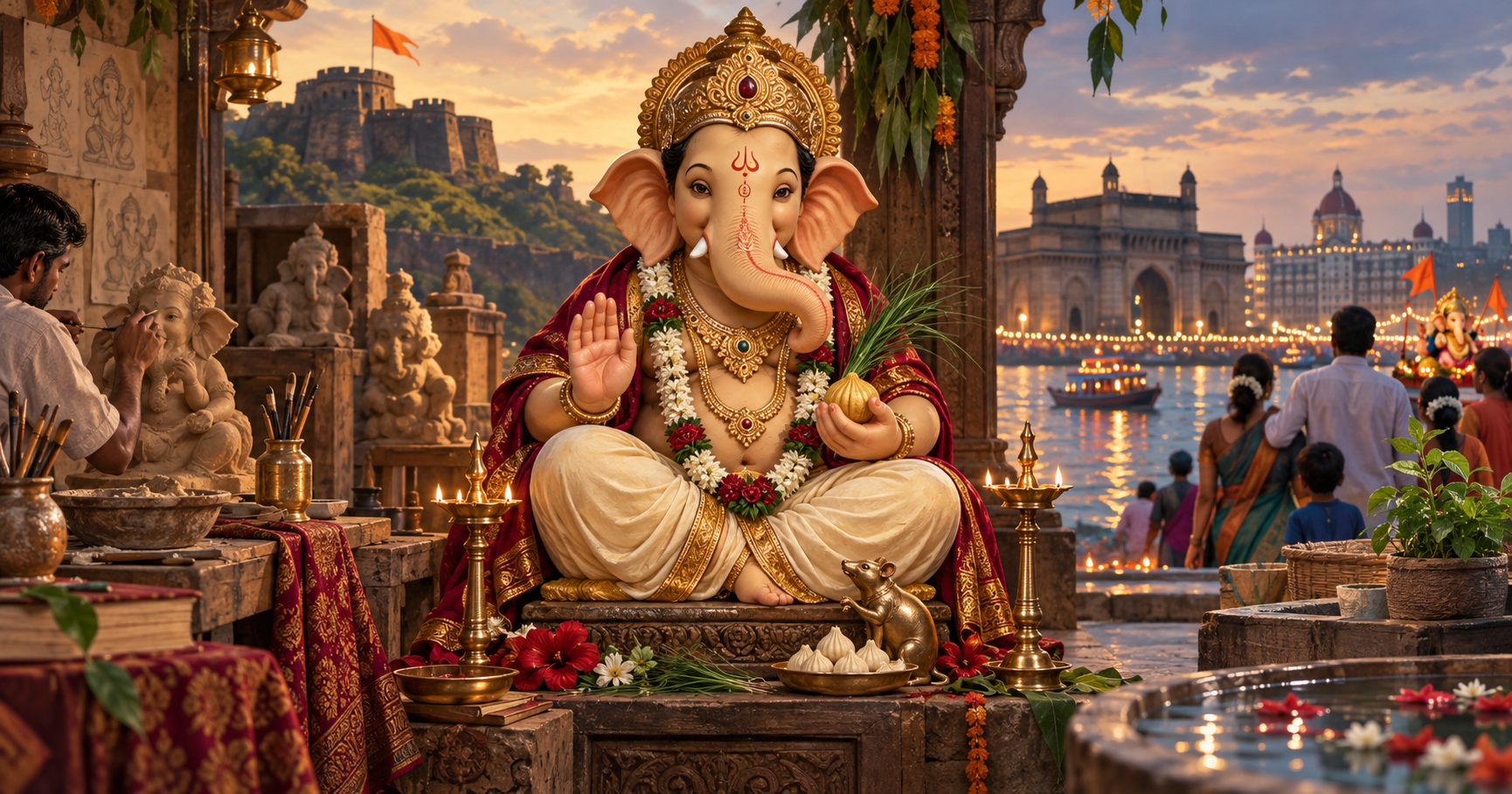

Ganapati history connects sacred tradition, changing artistic forms, Maharashtra’s social history, Mumbai’s neighbourhoods and modern environmental responsibility. Ganapati is worshipped as the remover of obstacles, a guide to wisdom and the deity invoked at auspicious beginnings. The complete story of Bappa is larger than a single festival.
Ganapati history: names, symbols and meanings
Ganesha is known by many names, including Ganapati, Vinayaka, Vighneshvara and Ekadanta. Devotees commonly honour him before a new undertaking and seek his blessings for wisdom, clarity and the removal of obstacles. Familiar features such as the elephant head, large belly, broken tusk, modaka and mouse vehicle carry layers of religious and artistic meaning that have developed across different texts, regions and periods.
The word ganapati is ancient and can mean “lord or leader of groups.” An early use of the title should not automatically be treated as proof of the fully recognisable elephant-headed Ganesha. The name, Vinayaka traditions, elephant symbolism and the familiar iconography have their own histories. Surviving sculptures and written traditions help scholars trace this development, but they do not support one simple date on which “Ganapati began.”
Sacred stories and historical evidence are not the same thing
One of the best-known sacred accounts says that Parvati created a child to guard her privacy. Shiva, not recognising him, confronted and beheaded him; the child was restored with an elephant’s head and received an honoured place among the gods. Other texts and regional traditions tell the story differently.
These narratives are important expressions of faith. Archaeology asks a different question: when do recognisable images of Ganesha appear, and how do their features change? Both perspectives matter, but one should not be used to disguise the other. A reliable Ganapati history account keeps devotional tradition and historical evidence clearly identified.
Ganapati worship continues throughout the year
Ganapati devotion is not limited to the annual festival. Hindu lunar calendars generally include two Chaturthi tithis each month:
- Vinayaka Chaturthi during the waxing half of the lunar month.
- Sankashti Chaturthi during the waning half, observed by many devotees with fasting and worship.
When Sankashti falls on a Tuesday, it is commonly called Angaraki Sankashti. Maharashtra also has traditions connected with Maghi Ganesh Jayanti. These observances should not be casually merged into one universal “birthday” claim; regional and devotional traditions may explain them differently.
Ganapati history and the rise of the public festival
Ganapati worship and household celebrations existed long before the modern public festival. During the late nineteenth century, community celebrations grew into a major social institution in Maharashtra. Lokmanya Bal Gangadhar Tilak is widely associated with expanding and popularising the public—or Sarvajanik—form in the 1890s as a means of community participation during colonial rule.
A careful history therefore should not say that Tilak “invented Ganesh Chaturthi.” His importance lies in helping transform and popularise its organised public form. Maharashtra Tourism identifies 1893 as a landmark in this development, while histories of early community celebrations include local claims that require their own documentation.
Ganapati history in Mumbai’s neighbourhoods
Mumbai’s festival grew through its chawls, working-class neighbourhoods, markets, artisan networks and public mandals. Girgaon, Lalbaug, Parel and other areas developed their own community identities. Mandals became spaces not only for worship but also for decoration, performance, education, charity and neighbourhood organisation.
This living history belongs to many people: murtikars, painters, flower sellers, sweet makers, decorators, electricians, carpenters, musicians, transport workers, photographers, sanitation workers, volunteers, police and civic staff. The ten public days are the visible centre of a much longer preparation cycle.
The journey of the festival
- Preparation: Families and mandals select a murti, plan the space, organise decoration and prepare offerings.
- Arrival and installation: Bappa is welcomed and installed according to household or community tradition.
- Daily worship: Aarti, prayers, modak, durva and other offerings form part of the devotional rhythm.
- Community life: Public mandals may organise cultural programmes, social initiatives and neighbourhood services.
- Visarjan: The farewell expresses impermanence, return and the promise of welcoming Bappa again. Families may keep the murti for different periods; not everyone follows an identical schedule.
For a child, the central idea can be expressed simply: people welcome Bappa with love, learn and celebrate together, then say goodbye with the hope that he returns next year.
Ganapati history and the 32 traditional forms
The Dvatrimsha Ganapati are a traditional set of thirty-two forms described through an iconographic and devotional classification. They should not be presented as the only forms of Ganesha, nor should every form be given an invented mythological story. Textual descriptions and artistic representations can also vary.
The commonly presented sequence is:
- Bala Ganapati
- Taruna Ganapati
- Bhakti Ganapati
- Vira Ganapati
- Shakti Ganapati
- Dvija Ganapati
- Siddhi Ganapati
- Uchchhishta Ganapati
- Vighna Ganapati
- Kshipra Ganapati
- Heramba Ganapati
- Lakshmi Ganapati
- Maha Ganapati
- Vijaya Ganapati
- Nritya Ganapati
- Urdhva Ganapati
- Ekakshara Ganapati
- Varada Ganapati
- Tryakshara Ganapati
- Kshipra Prasada Ganapati
- Haridra Ganapati
- Ekadanta Ganapati
- Srishti Ganapati
- Uddanda Ganapati
- Rinamochana Ganapati
- Dhundhi Ganapati
- Dvimukha Ganapati
- Trimukha Ganapati
- Simha Ganapati
- Yoga Ganapati
- Durga Ganapati
- Sankatahara Ganapati
Each form is distinguished through features such as colour, posture, number of arms, objects held, companions and devotional meaning. Before publishing illustrations as “accurate,” every image should be checked against the chosen traditional description. Artistic representations should be labelled as interpretations rather than historical temple reproductions.
Ashtavinayak, 32 forms and monthly Chaturthi are different traditions
Readers often combine three separate ideas. Ashtavinayak is a Maharashtra pilgrimage tradition centred on eight sacred sites. The 32 forms are an iconographic and devotional classification. Monthly Chaturthi observances belong to the lunar religious calendar. They are connected through Ganapati devotion but are not interchangeable lists.
The truth behind “Ganeshotsav revenue” headlines
There is no single audited number called “Ganeshotsav revenue.” News reports and trade bodies may estimate festival-related business activity, but different figures can include different cities, industries and time periods. Turnover is not the same as profit; donations are not the same as sponsorship; insurance cover is not income; and public expenditure is not festival earnings.
A responsible article should identify the year, geography, source and what was measured before quoting any amount. What can safely be said is that Ganeshotsav supports a wide temporary ecosystem—from artisans and food businesses to transport, events, retail and local services—while also requiring significant civic management.
From Pen to the world
Pen in Raigad is widely known as an important murti-making centre. The modern supply chain can extend from workshops and painters to packaging, road transport, ports, air cargo, customs and overseas community organisations. International transport requires early ordering, protective packaging and compliance with destination-country rules. Exact export quantities vary between reports and should not be repeated without current documentary verification.
Environment and responsible visarjan
The Central Pollution Control Board’s idol-immersion guidance addresses materials, paints, decorations and the protection of water bodies. A more responsible celebration considers the full lifecycle of the murti and decoration: material choice, size, paint, plastic use, transport, immersion arrangements, waste collection and possible reuse.
Local civic rules may change from year to year and place to place. Families and mandals should follow the latest municipal and pollution-control instructions for natural or artificial immersion facilities.
Ganapati in television, cinema and music
Television serials, films, animation and festival songs have strongly influenced how modern audiences visualise and celebrate Ganapati. They belong in a chapter on popular culture—not as proof of scripture or ancient history. Dates, episode counts, award claims and song credits should be checked against broadcasters, award organisations or official credits before publication.
A simple truth for children
Faith tells sacred stories about Bappa. History studies documents, objects and communities. Art shows how people imagined and represented him. Ganeshotsav brings families and neighbourhoods together. Asking questions does not weaken respect; it helps us understand which statement belongs to faith, which belongs to history and which is only an unverified forwarded message. Learning Ganapati history in this way encourages both curiosity and respect.
Continue exploring practical, carefully explained topics in the APICSTOCK Guides & Articles library.