

Updated: 15 September 2026
India concluded the 18th BRICS Summit in New Delhi on 12–13 September 2026 with the adoption of the New Delhi Declaration. The summit capped India’s rotating presidency of an expanded forum comprising 11 full members and 10 partner countries.
This updated guide explains the confirmed summit outcomes, India’s priorities and what they may mean for global governance, development finance, trade, technology and the Global South. It also separates adopted commitments from proposals—especially around the widely discussed idea of a “BRICS currency.”
BRICS 2026 at a glance
| Chair | India |
|---|---|
| Presidency began | 1 January 2026 |
| Full members | 11 |
| Partner countries | 10 |
| India’s 2026 theme | “Building for Resilience, Innovation, Cooperation and Sustainability” |
| How decisions are made | By consensus among full members |
| Leaders’ summit | 12–13 September 2026, New Delhi |
| Main test after the summit | Whether agreed initiatives produce measurable implementation |
What is BRICS?
BRICS is an informal intergovernmental forum for political dialogue, economic coordination and development cooperation among major emerging economies. Its name began as “BRIC,” an investment term coined in 2001 for Brazil, Russia, India and China. The four governments later turned the label into a diplomatic grouping and held the first BRIC leaders’ summit in 2009. South Africa joined in 2011, adding the “S.”
The forum expanded significantly from 2024. Egypt, Ethiopia, Iran and the United Arab Emirates became full members, and Indonesia formally joined in January 2025. Official BRICS material lists Saudi Arabia among the 11 full members. A partner-country category, created at the 2024 Kazan Summit, allows a wider group of countries to take part in leaders’ and foreign ministers’ meetings and, by consensus, other BRICS activities.
BRICS has no permanent treaty-based authority comparable to the European Union. It does not make laws for its members, operate a collective-defence clause or remove national borders for trade. Its influence comes from the political and economic weight of its members, regular ministerial work, shared institutions such as the New Development Bank, and the ability to coordinate positions in wider international forums.
How BRICS works
The presidency rotates annually. The chair hosts the leaders’ summit, sets priorities, coordinates ministerial and technical meetings, and guides negotiations. “Sherpas”—senior officials representing national leaders—prepare the agenda and negotiate language before major meetings. Finance, trade, health, education, agriculture, science, technology, security and people-to-people tracks run throughout the year.
Consensus is both a strength and a limitation. It gives every full member a voice, but it also means ambitious proposals can be slowed or diluted when national interests differ.
BRICS members and partner countries in 2026
Full members
| Country | Region | Membership note |
|---|---|---|
| Brazil | Latin America | Founding member |
| Russia | Europe / Asia | Founding member |
| India | South Asia | Founding member; 2026 chair |
| China | East Asia | Founding member |
| South Africa | Southern Africa | Joined in 2011 |
| Egypt | North Africa | Joined in 2024 |
| Ethiopia | East Africa | Joined in 2024 |
| Iran | West Asia | Joined in 2024 |
| United Arab Emirates | West Asia | Joined in 2024 |
| Indonesia | Southeast Asia | Formally joined in January 2025 |
| Saudi Arabia | West Asia | Listed in official BRICS material among 11 members |
Partner countries
| Region | Partner countries |
|---|---|
| Asia | Kazakhstan, Malaysia, Thailand, Uzbekistan, Vietnam |
| Africa | Nigeria, Uganda |
| Europe | Belarus |
| Latin America and Caribbean | Bolivia, Cuba |
Partner status is not the same as full membership. Partners can be invited to the summit and foreign ministers’ meeting, may join other sessions after consultation, and may associate themselves with final documents. Final BRICS decisions remain consensus decisions of the full members.
Why India’s BRICS presidency matters
India enters the 2026 presidency with a distinctive position. It is a founding BRICS member, a major economy, a prominent voice in the Global South and a country that also works closely with the United States, Europe, Japan and other Indo-Pacific partners. That gives New Delhi an opportunity to connect countries that do not always agree on geopolitics but may still cooperate on development, finance, health, technology and institutional reform.
The presidency also arrives after rapid expansion. A five-member forum has become a much broader coalition with more regional diversity and more complicated internal interests. India’s central challenge is therefore not expansion for its own sake. It is integration: making sure new members and partners can participate without turning every initiative into an unwieldy negotiation.
India’s four-part theme
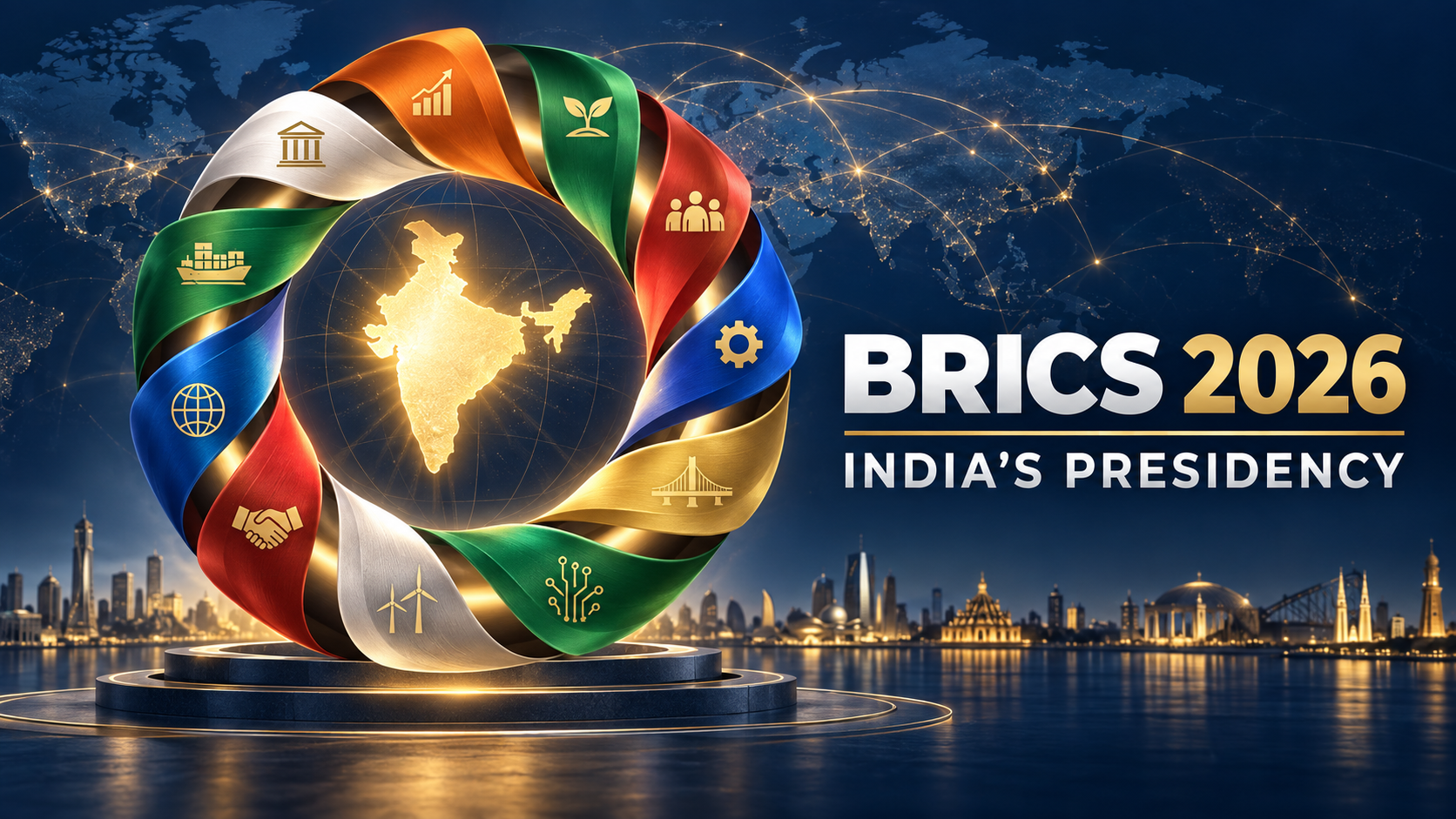
India launched the BRICS 2026 logo, theme and website on 13 January. The theme—Building for Resilience, Innovation, Cooperation and Sustainability—creates four practical tests for the presidency.
- Resilience: Can members reduce vulnerabilities in food, health, energy and supply chains?
- Innovation: Can they cooperate on digital public infrastructure, artificial intelligence, research and emerging technologies?
- Cooperation: Can a larger group improve its working methods and produce implementable projects?
- Sustainability: Can climate action, energy security and development needs be advanced together?
These themes are broad enough to accommodate different national priorities. The real measure of success will be the number and quality of deliverables attached to them.
BRICS 2026 timeline: what has happened so far
1 January: India assumes the presidency
India formally took over the rotating chair for 2026. The change began a year-long programme of officials’ meetings, ministerial tracks, working groups and preparations for the leaders’ summit.
13 January: logo, theme and official website launched
External Affairs Minister S. Jaishankar unveiled the identity for India’s chairship in New Delhi. The launch framed India’s approach around inclusivity, dialogue and shared growth, while introducing the resilience, innovation, cooperation and sustainability theme.
9–10 February: first sherpas and sous-sherpas meeting
The first sherpas’ meeting under India’s chairship took place in New Delhi. Sherpas do much of the detailed preparation behind leaders’ diplomacy: they align national positions, organise the work programme and negotiate language that may later appear in ministerial or summit documents.
14–15 May: BRICS Foreign Ministers’ Meeting
Foreign ministers and heads of delegation from member and partner countries met at Bharat Mandapam in New Delhi. The meeting addressed global and regional issues, reform of multilateral institutions and cooperation across the expanded BRICS framework. Its chair’s statement is an important mid-year reference point, but it is not a substitute for the leaders’ summit declaration.
12–13 September: 18th BRICS Summit and New Delhi Declaration
Leaders met in New Delhi under India’s theme, “Building for Resilience, Innovation, Cooperation and Sustainability,” and adopted the New Delhi Declaration. India reported more than 400 BRICS meetings and engagements across 30 cities during its presidency, extending participation beyond national capitals.
What happens next
The focus now moves from declaration language to implementation: financing projects, operating new knowledge and industrial-cooperation platforms, advancing technical work and measuring delivery. The declaration supported China as the BRICS chair and summit host for 2027.
New Delhi Declaration: confirmed summit outcomes
The declaration is broad rather than treaty-like, but it records several concrete institutions, frameworks and areas of follow-up:
- Global governance: renewed calls to reform the United Nations, UN Security Council, IMF, World Bank and WTO. China and Russia reiterated support for Brazil and India’s aspirations for a greater role in the UN and its Security Council.
- Development knowledge: launch of the BRICS–NDB Knowledge Portal to connect policy knowledge and development experience.
- Industry and MSMEs: establishment of the India Centre for BRICS Industrial Competencies, alongside cooperation on Industry 4.0, startups and small businesses.
- Science and technology: continued work through 14 science, technology and innovation groups, plus cooperation in remote sensing, digital health and artificial intelligence.
- Food, cities and climate: operational frameworks and declarations covering food security, sustainable urbanisation, climate cooperation, carbon markets and resilient development.
- Standards and intellectual property: progress on standards cooperation and continued coordination among BRICS intellectual-property offices.
- Expanded participation: partner-country involvement and the Outreach/BRICS Plus Dialogue were formally encouraged.
- 2027 transition: China received support to chair BRICS and host the next summit.
Prime Minister Narendra Modi also proposed a BRICS Seafarers Emergency Support Network. This should be treated as an Indian proposal requiring follow-through, not as a fully operational summit institution.
India’s priorities and the post-summit test
1. Reforming global governance
A consistent BRICS demand is that global institutions reflect current economic and demographic realities more accurately. This includes calls for reform of the United Nations, International Monetary Fund and World Bank, and for a larger role for emerging and developing economies.
Agreement on the principle is easier than agreement on the design. Members may support institutional reform while differing on Security Council representation, voting shares, eligibility rules or the pace of change. India will need to turn general declarations into specific, jointly supported positions.
2. Giving the Global South practical value
“Voice of the Global South” can become an empty phrase unless it improves access to finance, technology, markets, food security, health systems and climate resilience. India can use BRICS to bring the concerns of lower-income and developing countries into discussions among larger powers.
Partner-country participation is especially important here. It widens the range of regional experiences without automatically giving every participant the same decision-making role as a full member.
3. Digital public infrastructure and AI
India has experience building population-scale digital systems for identity, payments and service delivery. BRICS cooperation could focus on interoperable payments, digital inclusion, responsible AI, skills, research networks and affordable technology.
However, digital cooperation raises difficult questions about privacy, security, data governance, technical standards and national control. A credible outcome would define voluntary, transparent principles and pilot projects rather than promise a single BRICS digital system.
4. Resilient supply chains
BRICS members include large producers and consumers of energy, food, minerals, manufactured goods and technology. Better logistics, customs cooperation, standards recognition and market information could reduce friction. But supply-chain resilience should not be confused with economic separation from Western markets. Most BRICS economies remain deeply connected to global trade and finance beyond the grouping.
5. Climate action and energy security
Members share an interest in affordable development and greater climate finance, yet their energy systems differ sharply. Some are major fossil-fuel exporters, while others are large importers or fast-growing renewable-energy markets. India’s task is to find workable cooperation on clean energy, adaptation, resilient infrastructure, technology and finance without pretending that all members have identical transition paths.
Why BRICS matters economically
BRICS’ importance comes from scale. India’s Ministry of External Affairs has described the expanded grouping as representing roughly half of the world’s population, around 40% of global GDP and about a quarter of global trade. Exact shares vary by year, dataset and whether GDP is measured at market exchange rates or purchasing-power parity.
That distinction matters. PPP estimates are useful for comparing domestic purchasing power; nominal GDP is generally more relevant to international financial weight and exchange-rate exposure. Articles that combine the two create misleading headlines.
Trade and investment
BRICS is not a free-trade agreement, so businesses should not assume tariffs or regulations disappear. Its economic value may instead come from bilateral deals, business forums, sector working groups, customs cooperation, development finance and better payment connectivity.
For Indian companies, the expanded network creates opportunities in pharmaceuticals, digital services, engineering, renewable energy, food processing, education, logistics, manufacturing and professional services. It also increases the need for careful market research: regulations, sanctions exposure, currency risk and political conditions differ sharply across member countries.
The New Development Bank
The New Development Bank was established in 2015 by the five original BRICS members to mobilise resources for infrastructure and sustainable development in emerging markets and developing countries. It is a multilateral bank with its own governance and membership; it should not be treated as identical to the political BRICS forum.
According to the bank’s current project overview, it has approved about US$42.9 billion across 139 projects, with focus areas including clean energy, transport, water and sanitation, environmental protection, social infrastructure and digital infrastructure. Its portfolio demonstrates where BRICS cooperation can become tangible: financing projects rather than issuing declarations alone.
Local-currency lending is another area to watch. It can reduce some foreign-exchange risk for borrowers, but it does not remove currency risk from the financial system or create a common BRICS currency.
What BRICS 2026 could mean for Indian businesses
- Market diversification: A wider network can help exporters explore demand beyond traditional destinations.
- Payments: Better settlement links could lower delays and transaction costs in selected corridors.
- Infrastructure: Development-bank financing can create opportunities for engineering, construction, equipment and technology suppliers.
- Digital services: India’s strength in software, payments and digital public infrastructure may support partnerships and advisory work.
- MSMEs: Business-matching platforms and standards information can help smaller firms participate—if programmes are designed for usable access rather than only large conferences.
- Risk management: Firms must still assess sanctions, export controls, compliance, taxation, payment security and local law country by country.
The best commercial outcome would not be a dramatic headline. It would be reliable mechanisms that make cross-border business easier: verified buyer networks, standards guidance, transparent procurement, trade finance and predictable payment channels.
India, China and Russia: cooperation amid competition
BRICS is often analysed as if its members form a single geopolitical bloc. They do not. India and China cooperate in BRICS while managing a difficult bilateral relationship and competing interests in Asia. India maintains long-standing ties with Russia while expanding partnerships with the United States, Europe and Indo-Pacific countries. Brazil, South Africa, the UAE and other members also pursue multi-aligned foreign policies.
This diversity can limit common positions on security crises. It can also make BRICS useful: countries that disagree elsewhere retain a structured channel for dialogue. A balanced assessment should therefore avoid two extremes—calling BRICS a unified anti-Western alliance or dismissing it because members disagree.
BRICS currency: myth versus reality
No shared BRICS currency should be treated as an established 2026 fact. Several different ideas are often collapsed into one headline:
- settling more bilateral trade in national currencies;
- connecting payment systems;
- increasing local-currency lending by development banks;
- diversifying foreign-exchange reserves;
- creating a common unit of account; and
- launching a true shared currency.
The first three can advance through technical agreements without a euro-style monetary union. A genuine common currency would require far deeper coordination over monetary policy, exchange rates, financial regulation, fiscal rules and crisis support. BRICS members have very different economies and no common central bank.
The realistic 2026 story is therefore about payment options and financial resilience, not the overnight replacement of the US dollar. Even successful local-currency settlement would develop corridor by corridor and would coexist with dollar-based trade.
What BRICS can—and cannot—do
Potential strengths
- Convening major emerging economies across several regions
- Amplifying demands for reform of global institutions
- Financing infrastructure through the New Development Bank
- Building cooperation in health, science, education and technology
- Creating additional diplomatic space during periods of geopolitical tension
Structural limits
- Consensus can slow decision-making
- Members have different political systems and security interests
- Economic size and influence are unevenly distributed
- BRICS declarations are not automatically enforceable
- The grouping is not a customs union, military alliance or monetary union
Its effectiveness should be judged initiative by initiative. A modest programme with financing, deadlines and accountable institutions may matter more than a sweeping declaration without implementation.
What to watch after the New Delhi Summit
- Publication of implementation schedules, responsible agencies and measurable targets
- New Development Bank financing and project decisions linked to summit priorities
- Follow-through on UN Security Council, IMF, World Bank and WTO reform
- Use of the BRICS–NDB Knowledge Portal by governments and institutions
- Programmes delivered through the India Centre for BRICS Industrial Competencies
- Practical national-currency settlement or payment-connectivity pilots
- Implementation of climate, standards, health and food-security frameworks
- The handover to China’s 2027 chairship and continuity of India-led initiatives
Frequently asked questions
Which country chairs BRICS in 2026?
India holds the rotating BRICS presidency for 2026.
How many BRICS members are there?
Official BRICS and Indian government material lists 11 full members and 10 partner countries in 2026.
Is BRICS a military alliance?
No. BRICS is a political, economic and development-cooperation forum. It has no collective-defence commitment.
Is BRICS creating a common currency in 2026?
A common currency has not been established. Discussions about national-currency trade, payment systems and local-currency lending are separate from creating a shared currency.
What is the BRICS 2026 theme?
India’s theme is “Building for Resilience, Innovation, Cooperation and Sustainability.”
What is the difference between a member and a partner country?
Full members participate in consensus decisions. Partners can join specified meetings and may associate with final documents, but they do not have the same decision-making status.
What does BRICS mean for ordinary Indians?
The impact is indirect. Useful outcomes could improve development finance, export opportunities, payment links, technology cooperation, energy resilience and access to international partnerships. Benefits depend on implementation, not summit language alone.
Conclusion: the declaration is the start, not the finish
India’s presidency delivered a large programme—more than 400 engagements across 30 cities—and a leaders’ declaration spanning governance reform, development, technology, health, food security and sustainability. It also created or advanced practical platforms such as the BRICS–NDB Knowledge Portal and the India Centre for BRICS Industrial Competencies.
The real measure of BRICS 2026 will be whether these commitments gain budgets, institutions, timelines and public results. Useful development projects, workable digital and payment initiatives, resilient supply chains and clearer representation for developing countries would matter more than headline language alone.
Sources and methodology
This explainer prioritises official and primary sources. Membership and India-chairship information was checked against Government of India and official BRICS material. Development-finance figures were checked against the New Development Bank. Economic shares should always be read with their stated year and measurement method.
- Ministry of External Affairs, Government of India
- Official BRICS FAQ on members and partner countries
- New Development Bank overview
- New Development Bank project portfolio
- Official BRICS New Delhi Declaration, Government of India
- Prime Minister’s Office summary of the summit session
Editorial note: Updated after the 12–13 September 2026 summit using official publications. APICSTOCK will continue tracking implementation, financing and institutional follow-through. Claims based only on anonymous reports, social posts or speculation are excluded.