
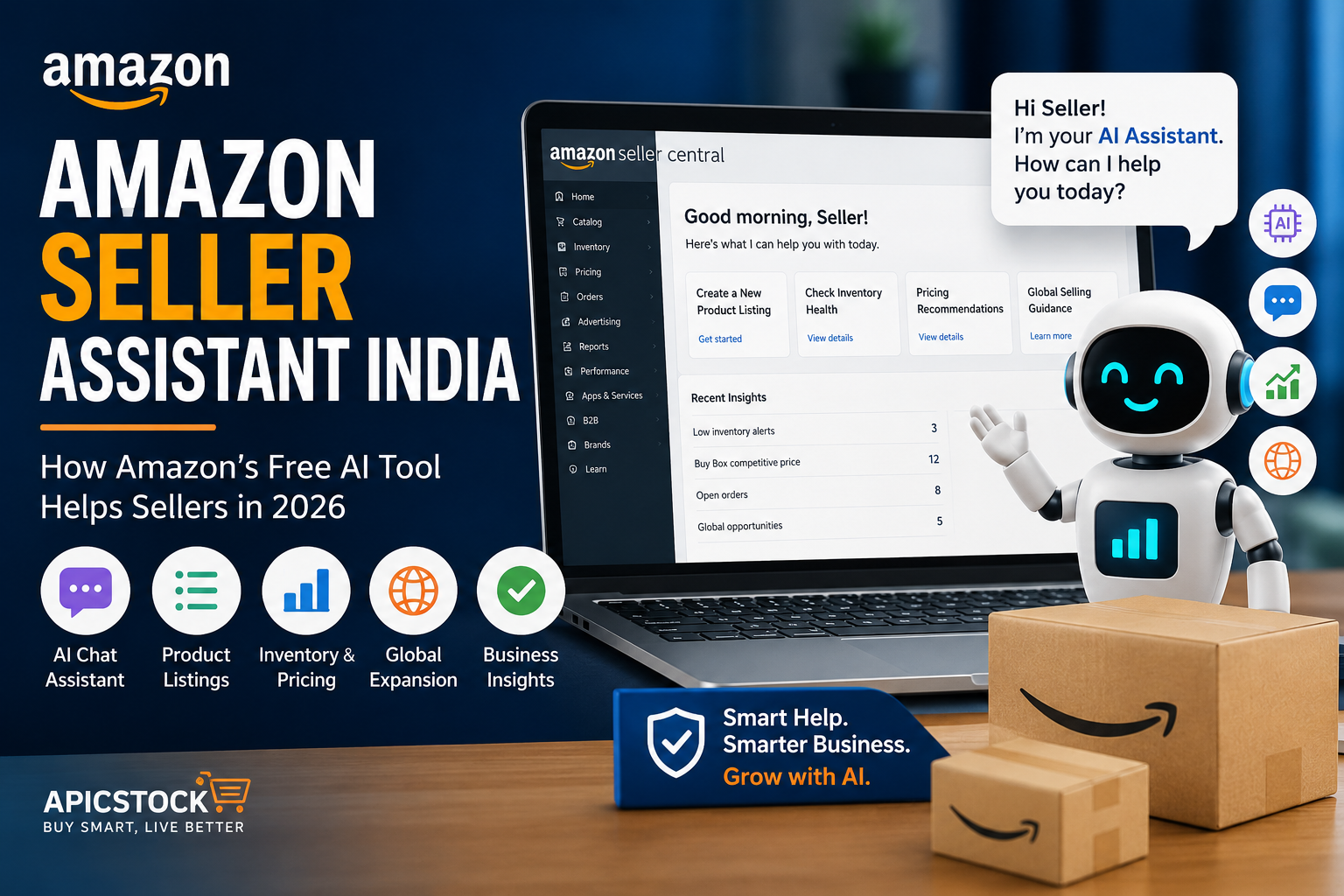

everyday marketplace tasks using AI. Amazon’s free AI-powered Seller Assistant is designed
to help sellers with product listings, inventory, pricing, orders and other selling-related
questions through conversational AI.
But is Amazon Seller Assistant actually useful for small sellers? And how much should sellers
trust AI when managing an online business? In this guide, APICSTOCK explains what the tool
can do, where it can save time, and what sellers should always verify before taking action.
Amazon Seller Assistant is a free AI-powered tool for Amazon.in sellers that provides
conversational guidance on listings, inventory, pricing, orders and other marketplace
activities. It can save sellers time, but important product information, fees, policies
and business decisions should still be verified by the seller.
What is Amazon Seller Assistant India?
Amazon Seller Assistant is an AI-powered business assistant designed for Amazon.in sellers.
Instead of searching through multiple seller resources, sellers can use conversational
questions to get guidance related to their Amazon business.
Amazon says Seller Assistant can help sellers with areas including:
- Product listings
- Inventory
- Pricing
- Orders
- Selling-related questions
- Business insights
- Global selling opportunities
The tool is particularly relevant to small businesses and entrepreneurs who manage their
own marketplace operations without a dedicated e-commerce team.
Why is Amazon introducing AI for sellers?
Running an online store involves many repetitive activities. Sellers have to create
listings, monitor inventory, understand pricing, manage orders, review performance and
make decisions about which products to sell.
Typical marketplace tasks include:
- Researching products.
- Creating product titles.
- Writing product descriptions.
- Adding product attributes.
- Monitoring inventory.
- Reviewing pricing.
- Managing orders.
- Understanding marketplace policies.
- Analysing business performance.
- Identifying potential growth opportunities.
AI can help reduce the time required for some of these activities, allowing sellers to
concentrate more on product selection, customer experience and business strategy.
How Amazon Seller Assistant India can help sellers
1. Product listings
Creating a good product listing can take considerable time. AI can help sellers organise
product information and create an initial draft for listing-related content.
Use AI to speed up listing creation, but always verify the final information before
publishing it to Amazon.
Important information to verify manually:
- Product dimensions
- Material
- Colour
- Compatibility
- Quantity
- Warranty
- Package contents
- Safety information
A faster listing process is useful only when the final listing remains accurate.
2. Inventory decisions
Inventory management is one of the biggest challenges for small online sellers.
Holding too much stock can tie up capital, while running out of stock can result in
missed sales.
Amazon’s AI-powered seller tools are designed to provide guidance around inventory and
business decisions.
Use AI to identify possible inventory decisions, but use your actual sales data,
margins and business situation before placing an order.
3. Pricing
Pricing is not simply about choosing the lowest price. Sellers need to understand their
complete cost structure before deciding whether a product is profitable.
Estimated Contribution
Selling Price
− Amazon Fees
− Shipping / Fulfilment
− Product Cost
− Returns
− Advertising
= Estimated Contribution
Amazon provides seller tools that can help businesses understand applicable selling fees
and estimate profitability.
4. Understanding Amazon’s selling ecosystem
New sellers can easily become overwhelmed by Amazon terminology, policies and seller
resources.
Seller Assistant can provide conversational guidance, making it easier to find relevant
information and understand marketplace-related questions.
Seller Assistant is not a replacement for Seller Central
This distinction is important.
Seller Assistant should be viewed as an AI assistance layer that helps
sellers understand and manage their business rather than as a replacement for Amazon
Seller Central.
Sellers still need to monitor their actual account, orders, fees, inventory, customer
issues and marketplace policy requirements.
Before making an important financial or operational decision, verify the information
against your Seller Central account and current official Amazon documentation.
The biggest advantage: conversational commerce for sellers
One of the most interesting aspects of Amazon’s approach is the use of natural language.
Sellers do not necessarily need to know which help page contains the answer before asking
a question.
For Indian marketplace businesses, Amazon Seller Assistant India represents
a broader shift toward AI-assisted e-commerce operations, where sellers can use artificial
intelligence to reduce repetitive work while retaining human control over important
decisions.
Amazon says Seller Assistant is available in English and Hinglish. This can make the tool
particularly relevant to Indian sellers who naturally mix English and Hindi when discussing
business operations.
Conversational AI can make sophisticated e-commerce tools easier for smaller businesses
and individual entrepreneurs to use.
What sellers should NOT do with AI
AI can save time, but careless automation can create problems.
Don’t blindly publish AI-generated:
- Product specifications
- Technical claims
- Medical or safety claims
- Warranty information
- Compatibility statements
- Legal or compliance statements
- Pricing claims
APICSTOCK Rule
AI drafts. The seller verifies.
Human verification remains especially important for products where incorrect information
could lead to customer complaints, returns, poor reviews or marketplace problems.
How Amazon Seller Assistant India fits into the future of e-commerce
The important story isn’t simply that Amazon launched another AI tool.
The bigger development is that AI is becoming part of the everyday operating
system of e-commerce businesses.
Buyer Side
AI-assisted discovery, recommendations, visual search, product comparisons and
shopping assistance.
Seller Side
AI-assisted listings, inventory management, pricing, advertising and business guidance.
The future e-commerce workflow may increasingly look like:
What small sellers should do now
If you’re selling on Amazon, start by identifying repetitive tasks that consume your time.
Then ask:
- Can AI help research this?
- Can AI create the first draft?
- Can AI analyse the information?
- Can AI identify patterns?
- What still requires human verification?
Don’t automate everything. Automate the repetitive parts and keep human control over
important business decisions.
A simple AI workflow for sellers
- Research: collect accurate product information.
- Draft: use AI to organise and prepare content.
- Verify: compare every important claim against reliable information.
- Publish: upload the final verified listing.
- Monitor: watch sales, returns, reviews and customer feedback.
- Improve: use real performance data to refine the listing and strategy.
Frequently Asked Questions
What is Amazon Seller Assistant?
Amazon Seller Assistant is an AI-powered tool designed to help Amazon.in sellers with
marketplace-related tasks such as listings, inventory, pricing, orders and business
questions.
Is Amazon Seller Assistant free?
Amazon describes Seller Assistant as a free AI-powered tool for Amazon sellers.
Does Amazon Seller Assistant replace Seller Central?
No. Seller Assistant should be treated as an AI assistance layer rather than a replacement
for Seller Central. Sellers should continue monitoring their actual seller account, orders,
fees, inventory and policy requirements.
Can Amazon Seller Assistant help create product listings?
Amazon’s AI seller tools can assist with listing-related tasks. Sellers should verify
specifications, dimensions, compatibility, materials, warranty information and other
important product details before publishing.
Does Amazon Seller Assistant support Hinglish?
Amazon says Seller Assistant is available in English and Hinglish, making it relevant to
Indian sellers who communicate using a mix of English and Hindi.
Should sellers trust AI-generated product information?
AI-generated information should always be verified against reliable product documentation
and the seller’s actual information before publication. Incorrect specifications or claims
can lead to customer complaints, returns or other marketplace problems.
Who can benefit most from Amazon Seller Assistant?
Small businesses, entrepreneurs and individual sellers who manage their own Amazon
operations may benefit particularly from an AI assistant that can help them find
information and handle repetitive marketplace tasks more efficiently.
Is AI going to replace Amazon sellers?
AI is more likely to automate parts of the selling workflow than eliminate the need for
sellers. Product selection, quality control, pricing strategy, customer understanding and
important business decisions still require human judgment.
APICSTOCK Verdict
Amazon Seller Assistant India is an important development because it brings AI directly
into the workflow of Indian marketplace sellers.
Its biggest potential is not simply writing product descriptions. The larger opportunity
is helping sellers understand their business faster and make better decisions.
For small businesses that don’t have dedicated e-commerce teams, this type of AI assistance
could become increasingly valuable.
APICSTOCK Takeaway
AI won’t eliminate the need for good sellers. It will increasingly reward sellers who
know how to combine AI with accurate product information, marketplace data and human
judgment.
Sources
Amazon India — Seller Assistant
Editorial note:
Amazon features, fees and seller policies can change. Always verify current terms in
Amazon Seller Central and official Amazon documentation before making financial or
operational decisions.