
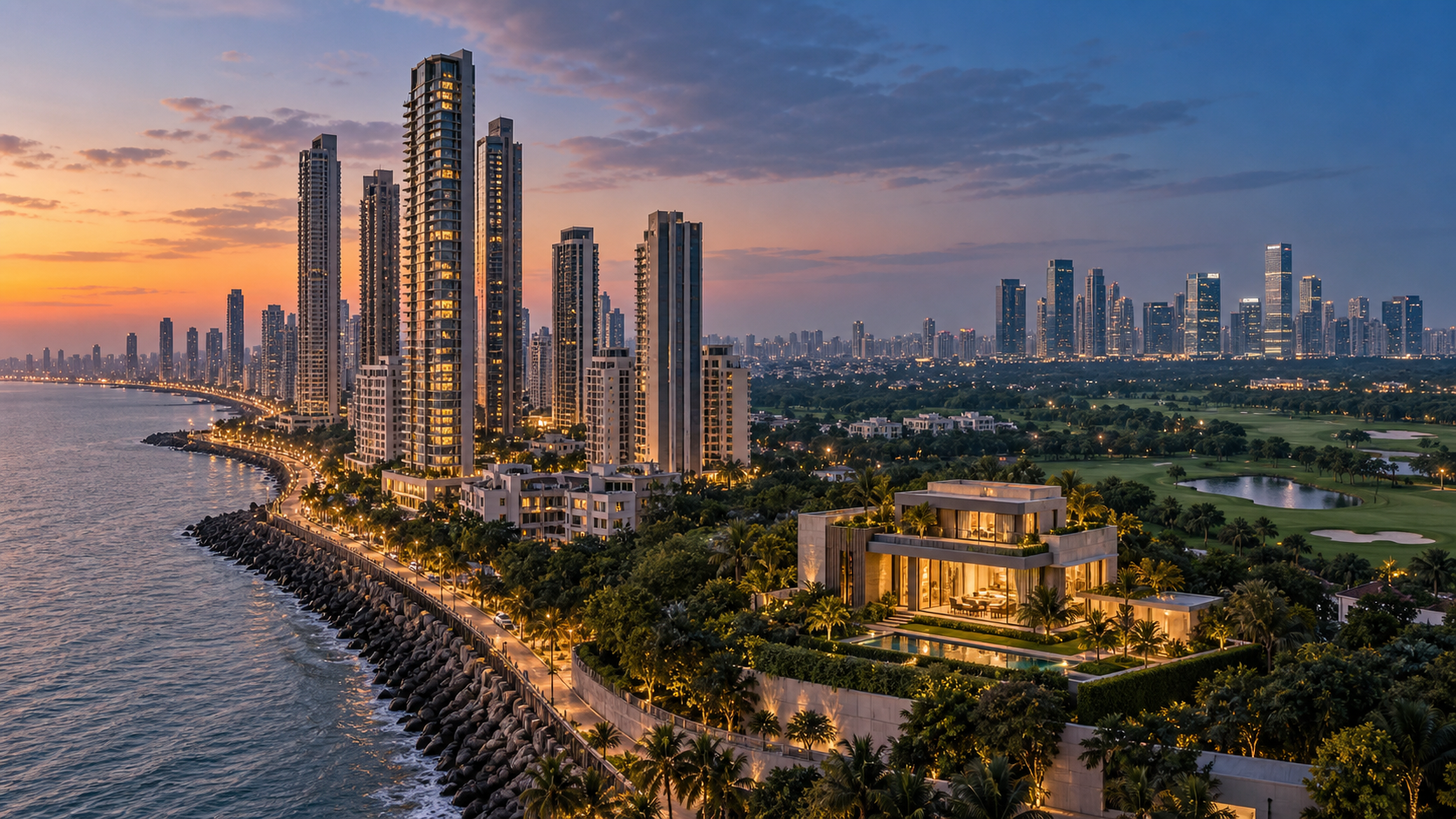

India’s costliest properties are more than enormous homes: they are stories about scarce land, business wealth, architecture, privacy and the changing geography of status. Mumbai’s sea-facing neighbourhoods still dominate record transactions, while Gurugram has created a different form of luxury around golf-course communities and large serviced residences.
Editorial note: India has no official continuously updated ranking of private-home values. Registered sale consideration, taxes, project disclosures, asking prices and media estimates are different measurements. This article clearly labels them and does not treat an estimated value as a completed transaction. It is informational, not investment advice.
Quick comparison: India’s most expensive residential properties
| Property | Location | Why it is notable | Price basis |
|---|---|---|---|
| Naman Xana duplexes | Worli, Mumbai | Widely reported 2025 national residential transaction record | Approximately ₹639 crore consideration; about ₹703 crore including reported duties and taxes |
| Lodha Malabar triplex | Malabar Hill, Mumbai | Large sea-facing registered apartment transaction | Approximately ₹369 crore reported registered consideration |
| Antilia | South Mumbai | India’s best-known purpose-built private residence | Privately held; public figures are estimates, not a sale price |
| Three Sixty West residences | Worli, Mumbai | Repeated ₹100-crore-plus tower transactions | Individual registered transactions vary |
| The Camellias | Gurugram | North India’s defining super-luxury apartment community | Resale and disclosed project prices vary by residence |
| JK House | South Mumbai | Industrial-family residence built vertically on scarce land | Private property; media estimates only |
| Gulita | Worli, Mumbai | Sea-facing residence associated with a major business family | Private transfer; reported estimates vary |
| Mannat | Bandra, Mumbai | Heritage bungalow transformed into a cultural landmark | Not recently sold; estimates are speculative |
1. Naman Xana: the transaction that reset India’s price record
In May 2025, two sea-facing duplex apartments in the Naman Xana development at Worli were purchased in a transaction widely reported as India’s most expensive residential deal. Property-data reporting placed the consideration near ₹639 crore and the all-in amount, including stamp duty and GST, around ₹703 crore. The combined area was reported at approximately 22,500 square feet.
The story behind the price: this was not simply a purchase of floor area. Worli combines uninterrupted Arabian Sea views, improving road connectivity, proximity to major business districts and an extremely limited supply of very large new homes. Combining two duplexes created a scale that normal apartment inventory cannot provide. The record therefore reflects scarcity, configuration and privacy as much as marble or amenities.
The deal also illustrates why headlines must distinguish the registered consideration from taxes and duties. Both numbers may be accurate, but they answer different questions. Market context: CRE Matrix luxury-housing research.
2. Lodha Malabar: a modern Art Deco story on Malabar Hill
A large triplex at Lodha Malabar was reported as a roughly ₹369-crore registered purchase in 2025. The development sits at Walkeshwar opposite the Governor’s Estate, with sea and green views from one of Mumbai’s most protected high-value residential districts.
The story behind the property: Malabar Hill’s value is rooted in geography and history. It is elevated, close to South Mumbai institutions and far less densely available for new construction than most neighbourhoods. Lodha describes the project as a contemporary tribute to Mumbai’s Art Deco heritage and says it contains only 36 residences. That combination—large land parcel, very low inventory, heritage-inspired design and enduring views—turns the address into a scarcity product.
The project is registered under MahaRERA number P51900034949. Buyers evaluating even the most prestigious project should still verify the current RERA record, approvals, carpet area and executed agreement. Official project information: Lodha Malabar.
3. Antilia: when a private home became part of a city’s identity
Antilia is the 27-storey Mumbai residence associated with Mukesh Ambani and his family. It occupies a prominent position in South Mumbai and is frequently described as one of the world’s most valuable private homes. Exact construction cost and current value are not publicly verified through a market sale, so billion-dollar figures repeated online should be understood as estimates.
The story behind the property: Antilia emerged during a period when Indian companies were becoming global in scale and Mumbai land was growing dramatically more scarce. Instead of spreading a large estate horizontally, the residence translated the mansion into a vertical form. Its importance is therefore architectural and symbolic: a single-family high-rise that made private wealth part of the public skyline.
Its name refers to the mythical Atlantic island of Antillia. The project has been associated in architectural reporting with international design and hospitality specialists. Yet the most enduring fact is not a speculative valuation—it is how quickly the building became a visual shorthand for twenty-first-century Indian wealth.
4. Three Sixty West: turning Worli’s skyline into a luxury address
Three Sixty West is a pair of prominent towers in Worli with residences that have repeatedly appeared in registered ₹100-crore-plus transactions. The development’s height, sea views, large apartment formats and hospitality-led positioning place it within Mumbai’s trophy-home market.
The story behind the property: Worli was once strongly associated with mills and industrial land. Over several decades it became a central luxury corridor connecting South Mumbai with Bandra-Kurla Complex and other employment centres. Towers such as Three Sixty West represent that economic transition: former industrial geography converted into vertical residential capital.
Prices differ greatly according to tower, floor, carpet area, view, parking and transaction date. A spectacular resale headline should never be used as the automatic value of another unit in the same project.
5. The Camellias: Gurugram creates its own luxury language
DLF’s The Camellias in Sector 42, Gurugram, has produced some of North India’s largest reported apartment transactions. DLF has described it as the most luxurious offering in its super-luxury portfolio, following The Aralias and The Magnolias.
The story behind the property: unlike Mumbai, where the sea and scarce island-city land dominate value, The Camellias builds its identity around a controlled green environment. Its official project material highlights golf-course views, extensive greenery, water landscapes and a large residents’ club. Architecture by Hafeez Contractor and work by international specialists helped position the project closer to a private resort than a conventional apartment complex.
DLF’s official material describes sixteen towers of varying heights, while its 2021 club release refers to a community of 429 apartments across nine residential towers around the club context. Buyers should use the exact sanctioned and contractual project documents for technical counts and specifications. DLF has also stated that the development achieved LEED Platinum certification. Official source: The Camellias.
6. JK House: a vertical family estate in old Mumbai
JK House is a private high-rise residence associated with the Singhania family and the Raymond business legacy. Public reporting has linked the tower to residential floors, leisure facilities and family spaces, but precise internal specifications and valuations vary across publications.
The story behind the property: industrial families in Mumbai historically lived in large bungalows or estates. As land values rose and family requirements changed, the vertical residence offered another model: retaining a prestigious location while stacking privacy, recreation and household functions upward. JK House therefore represents the evolution of an old business-family estate into a modern urban tower.
7. Gulita: a sea-facing home tied to industrial legacy
Gulita is the Worli residence associated with Isha Ambani and Anand Piramal. It has been widely reported as a gift connected with their marriage and as a property formerly linked to Hindustan Unilever. Exact value claims vary and should not be treated as a recent open-market sale price.
The story behind the property: its importance comes from the meeting of two major business-family histories and a location overlooking the sea. The residence also shows how trophy homes can move through corporate and private ownership before becoming family landmarks. Its distinctive façade makes it recognisable, but its market value remains difficult to establish without a comparable current transaction.
8. Mannat: how a heritage home became cultural property
Mannat, the Bandra residence of actor Shah Rukh Khan and his family, is not necessarily among India’s largest homes and has not recently established a registered national price record. It belongs in this discussion because public fascination has turned it into one of India’s most recognisable private addresses.
The story behind the property: the sea-facing heritage bungalow, formerly known as Villa Vienna, became connected to Khan’s rise in Indian cinema. Fans gathering outside transformed a private residence into a cultural landmark. Its value cannot be explained only by square feet: heritage character, Bandra’s coastal scarcity and association with a globally recognised individual create an intangible premium that ordinary valuation models cannot measure reliably.
Why are India’s costliest homes concentrated in Mumbai?
- Physical scarcity: coastal geography limits prime land.
- Economic concentration: finance, entertainment and corporate leadership create deep luxury demand.
- View protection: uninterrupted sea or green views are difficult to reproduce.
- Large-format shortage: combining multiple apartments or securing a bungalow-sized plot is rare.
- Connectivity: bridges, coastal roads and proximity to business districts reshape the value of central neighbourhoods.
- Identity: certain buildings become recognised addresses whose reputation attracts another premium.
What ordinary buyers can learn from trophy-property stories
These homes are not realistic benchmarks for most purchases, but the same underlying principles matter at every budget. Verify carpet area instead of relying on super built-up figures. Check the legal promoter and state RERA registration. Study access, water, maintenance, future construction and resale liquidity. Separate an asking price from a registered deal. Most importantly, never assume that a famous owner, architect or developer removes project-level risk.
Frequently asked questions
Which is the most expensive house in India?
Antilia is commonly described as India’s most valuable private residence, but its public valuation is estimated because it has not established a recent open-market sale price. For a completed transaction, the 2025 Naman Xana duplex purchase is widely reported as the national residential record.
Was the record deal ₹639 crore or ₹703 crore?
Approximately ₹639 crore was reported as the property consideration, while roughly ₹703 crore represents the wider all-in amount after reported stamp duty and GST. Articles should identify which measure they use.
Does a celebrity connection prove property value?
No. It can create cultural or scarcity value, but a defensible market valuation still requires title checks, physical inspection, comparable transactions and professional analysis.
Are ultra-luxury homes safe investments?
Not automatically. They can have high carrying costs, a limited buyer pool and transaction-specific legal or tax issues. Buyers need independent legal, financial and technical advice.
Final perspective
India’s costliest properties tell several different stories. Naman Xana represents a verified transaction benchmark. Lodha Malabar reflects Malabar Hill scarcity and Art Deco heritage. Antilia made the private vertical mansion globally visible. Three Sixty West tracks Worli’s reinvention, while The Camellias shows Gurugram’s golf-and-green alternative to Mumbai luxury. JK House, Gulita and Mannat reveal how business and cultural histories can become inseparable from an address.
Explore more independent property and city-development articles in the APICSTOCK Guides & Articles hub, including our comparison of the top real estate developers in India.