

Affiliate Disclosure: APICSTOCK participates in the Amazon Associates Program. We may earn from qualifying purchases made through links on this page, at no additional cost to you. Prices and availability can change.
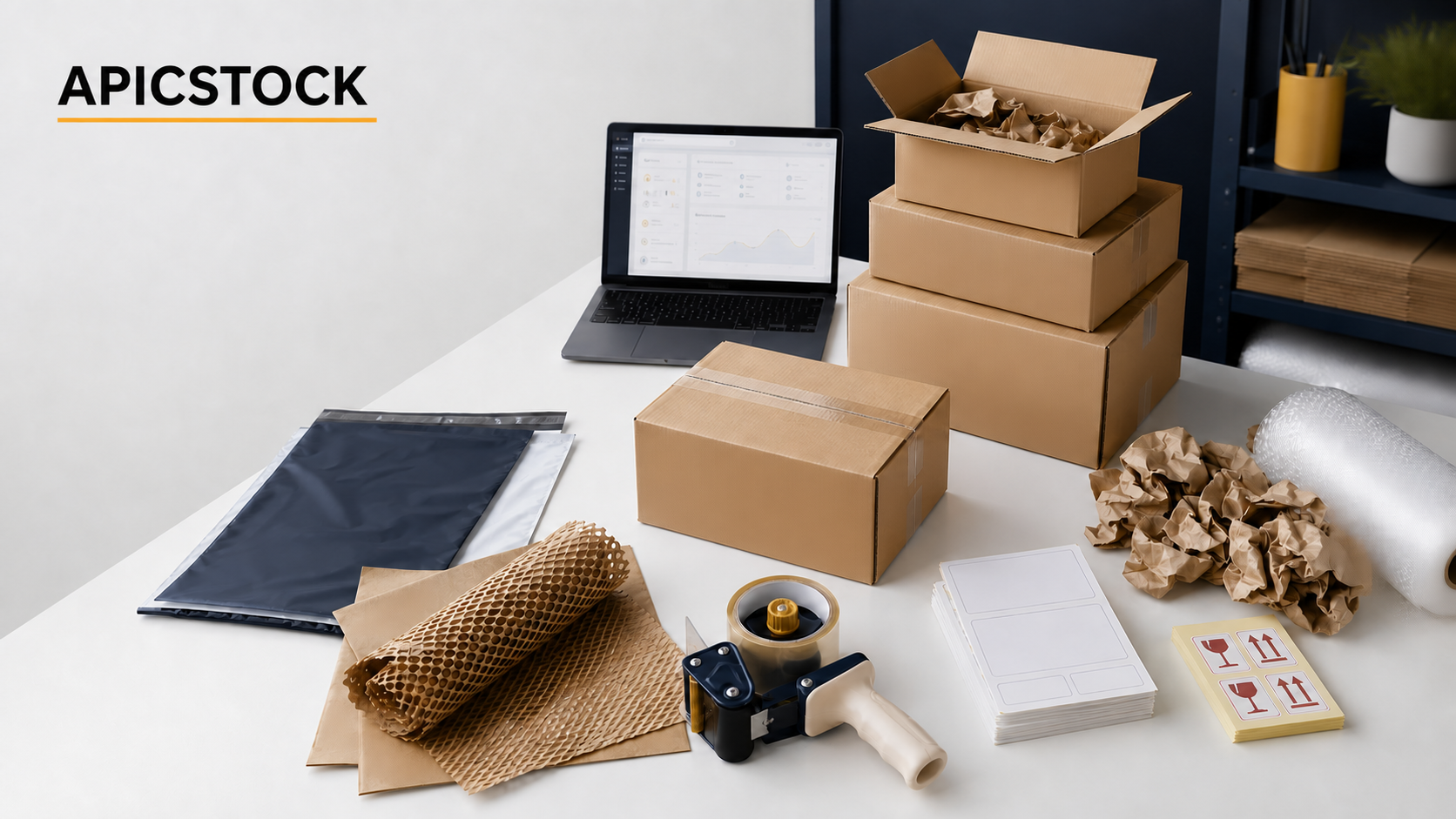
The best packaging materials for e-commerce sellers protect products through repeated handling without adding unnecessary size, weight or cost. A reliable packing station normally combines correctly sized corrugated boxes or courier bags, cushioning, void fill, strong tape, clear labels and basic measuring tools.
Quick answer: Use a correctly sized corrugated box for fragile, rigid or high-value products; tamper-evident courier bags for suitable non-fragile items; bubble wrap or paper cushioning for impact protection; paper void fill for movement control; pressure-sensitive packing tape for secure closure; and direct thermal 4 × 6 labels for compatible shipping workflows. Always follow the marketplace or courier’s current rules for the exact product being shipped.
This guide explains what each material does, when to use it and what to verify before buying. It avoids fixed prices because pack quantity, thickness, size, seller and delivery charges can change.
Best Packaging Materials for E-commerce Sellers: Quick Comparison
| Material | Main Purpose | Best For | Common Mistake |
|---|---|---|---|
| Corrugated boxes | Structural protection | Fragile, rigid and valuable products | Using an oversized or weakened box |
| Courier bags | Lightweight tamper-evident outer packaging | Clothing and suitable non-fragile items | Using them for crush-sensitive products |
| Bubble wrap | Impact cushioning | Glass, electronics and delicate surfaces | Leaving corners and edges exposed |
| Paper cushioning | Wrapping and void fill | General products and plastic-reduction goals | Using too little to stop movement |
| Air pillows | Lightweight void fill | Filling empty space around non-sharp products | Using them as the only protection for fragile items |
| Packing tape | Carton closure | Corrugated boxes | Applying tape to dusty or damp cardboard |
| Tape dispenser | Faster, consistent sealing | Regular packing desks | Using an exposed blade carelessly |
| Shipping labels | Routing and identification | Courier and marketplace shipments | Covering codes with reflective or wrinkled tape |
| Warning labels | Handling communication | Fragile, liquid or orientation-sensitive parcels | Expecting a sticker to replace protective packaging |
1. Corrugated Shipping Boxes
Corrugated boxes provide the primary structure for products that can bend, break, dent or lose their shape. The correct box should be strong enough for the product and journey while leaving only the space required for protective cushioning.
Choose the Right Size
An oversized carton needs more void fill, increases dimensional size and allows the product to move. A box that is too tight leaves no room for cushioning and may transfer impact directly to the product. Build a small range of standard box sizes around your most common orders rather than forcing every shipment into one carton.
Inspect Box Condition
Do not use a box with crushed corners, torn flaps, moisture damage or deeply weakened folds. Reused boxes can reduce waste, but only when their structure remains reliable and all old labels and barcodes are completely removed or covered.
Single-Wall vs Stronger Construction
Light, durable products may suit a basic single-wall carton. Heavy, fragile or high-value products can require a stronger board construction or an inner-and-outer box arrangement. Choose according to actual product risk rather than a marketing label alone.
APICSTOCK Verdict: The default outer package for fragile, rigid and valuable products. Keep multiple tested sizes so you can reduce empty space.
Check corrugated shipping boxes on Amazon.in
2. Tamper-Evident Courier Bags
Courier bags are lightweight, space-efficient and quick to close. They work well for flexible, non-fragile products such as clothing when the product is already protected inside an appropriate inner bag or wrap.
They are not a substitute for a box when the contents can crack, bend, puncture the bag or become damaged under pressure. Select a size that closes without stretching and leaves a smooth surface for the shipping label.
What to Check
- Bag dimensions and usable internal space.
- Material thickness and seam quality.
- Strength of the tamper-evident adhesive strip.
- Water resistance claimed by the supplier.
- Whether a document pouch is included or required.
- Applicable plastic-packaging and labelling obligations.
APICSTOCK Verdict: Efficient for suitable soft goods, but never force crush-sensitive products into a courier bag simply to reduce packing cost.
Check tamper-evident courier bags on Amazon.in
3. Bubble Wrap
Bubble wrap cushions products against impact and surface contact. It is useful for glassware, electronics, cosmetics in rigid containers and other delicate items, but its effectiveness depends on complete coverage and correct placement.
Wrap the item so vulnerable corners and edges receive protection, secure the wrap without damaging the product and then prevent the wrapped item from moving inside the outer carton. For especially fragile products, combine wrapping with a suitable inner box, dividers or additional cushioning.
What Bubble Wrap Cannot Do
- It cannot make a weak outer carton strong.
- It cannot prevent leakage from an improperly sealed liquid container.
- It cannot replace void fill when the product moves freely.
- It does not guarantee safe delivery.
APICSTOCK Verdict: A practical impact layer for fragile products, provided it is combined with a strong carton and movement control.
Check bubble-wrap rolls on Amazon.in
4. Paper Cushioning and Honeycomb Wrap
Kraft paper can wrap surfaces, separate items and fill empty space. Honeycomb-style paper expands into a cushioning structure that can protect suitable products while giving the package a cleaner paper-based presentation.
Paper is not automatically the lowest-impact choice in every situation; material use, recycled content, recyclability in the customer’s location and damage prevention all matter. The most sustainable package is often the smallest system that protects the product successfully.
Best Uses
- Wrapping non-sharp surfaces.
- Separating multiple items in one carton.
- Filling moderate gaps.
- Creating a premium unboxing presentation.
APICSTOCK Verdict: A versatile cushioning and void-fill choice for sellers aiming to reduce unnecessary plastic without increasing damage.
Check paper and honeycomb packaging on Amazon.in
5. Void Fill and Air Pillows
Void fill prevents the packed product from sliding, bouncing or colliding with the carton walls. Crumpled paper, corrugated inserts and air pillows can fill space, but each serves a different risk profile.
Air pillows add little weight and work well around suitable non-sharp items. They can puncture and are not a complete cushioning system for heavy or fragile products. Paper is denser but adapts around irregular shapes. Custom corrugated inserts provide better positioning when order volume justifies them.
Simple Movement Test
After sealing a test parcel, move it gently. If the product shifts noticeably, improve its positioning before dispatch. Do not perform aggressive drop testing unless you have a controlled packaging-test process and safe test samples.
APICSTOCK Verdict: Choose void fill by product weight and fragility. Its job is to immobilise the product, not merely make the carton look full.
Check void-fill materials on Amazon.in
6. Packaging Tape
Packaging tape holds the carton closed through handling, stacking and transport. Select tape that bonds reliably to your carton surface and performs under the storage and delivery conditions your orders experience.
Apply tape to clean, dry cardboard with sufficient pressure. A common H-style closure seals the centre seam and the two edge seams on the top and bottom of the carton. Heavy cartons may require a stronger documented sealing method.
Transparent, Brown or Printed Tape?
Colour matters less than adhesive performance and correct application. Printed tamper-evident or branded tape can improve presentation and make interference more visible, but it should not replace secure closure.
APICSTOCK Verdict: Buy consistent-quality tape sized for your dispenser and carton type. Weak adhesive can undo every other packing decision.
Check packaging tape on Amazon.in
7. Tape Dispensers
A handheld tape dispenser improves speed and gives more consistent tension and cutting than applying every strip by hand. It becomes valuable as soon as repetitive packing begins to slow the dispatch process.
What to Check
- Compatibility with your tape width and core size.
- Comfortable grip and balanced weight.
- Adjustable tension.
- A guarded cutting blade.
- Easy roll replacement.
Train users to keep fingers clear of the blade and store the dispenser safely. A damaged or exposed cutter should be replaced.
APICSTOCK Verdict: A low-complexity tool that can improve packing consistency and reduce wasted tape at a busy desk.
Check tape dispensers on Amazon.in
8. Thermal Shipping Labels
Direct thermal labels create clear shipping labels without ink or toner when paired with a compatible direct thermal printer. The roll or stack must match the printer’s supported media width, sensing method, core arrangement and marketplace workflow.
Many shipping workflows use approximately 4 × 6-inch labels, but never assume one format fits every courier or printer. Confirm the required label size in the current seller or shipping portal and check whether your printer uses rolls or fanfold media.
Label Application Tips
- Apply the label to a flat, clean surface.
- Do not fold a barcode over a carton edge.
- Remove or fully cover obsolete labels and barcodes.
- Avoid wrinkles, bubbles and reflective tape over scannable areas.
- Test barcode readability before dispatching a batch.
APICSTOCK Verdict: Use compatible, consistently coated labels that remain readable through the expected shipping journey.
Check 4 × 6 thermal shipping labels on Amazon.in
9. Warning, Fragile and Orientation Labels
Handling labels communicate important information such as fragile contents, upright orientation or liquid risk. They can help handlers understand the package, but they do not compensate for weak packaging.
Place labels where they remain visible without covering the address, tracking code or required declarations. Use only truthful instructions that match the contents and carrier rules.
APICSTOCK Verdict: Helpful communication for relevant shipments—not a substitute for cushioning, containment or a strong outer package.
Check fragile and handling labels on Amazon.in
Packaging Recommendations by Product Type
| Product Type | Suggested Starting System | Important Check |
|---|---|---|
| Clothing | Inner protective bag plus correctly sized courier bag or box | Moisture and tamper protection |
| Books | Snug corrugated mailer or box with edge protection | Prevent bent corners and moisture exposure |
| Electronics | Protective inner packaging, cushioning and rigid outer carton | Battery and carrier restrictions |
| Glassware | Individual wrapping, dividers or inner box, void fill and strong outer carton | No item-to-item or wall contact |
| Liquids | Secure primary closure, leak containment, absorbent protection and strong outer packaging | Marketplace and carrier acceptance rules |
| Cosmetics | Seal against leakage, wrap rigid containers and immobilise inside carton | Fragile caps, pumps and temperature sensitivity |
| Multiple items | Separate items, protect each risk point and fill all movement space | Products cannot collide in transit |
Build a Practical Packing Station
- Inspect the order: Confirm product, quantity and condition.
- Select the outer package: Use the smallest suitable box or bag.
- Protect the product: Wrap, seal or separate vulnerable areas.
- Control movement: Add only enough void fill to immobilise the contents.
- Seal securely: Use a repeatable taping method.
- Measure and weigh: Record final packed dimensions and weight.
- Apply the label: Keep codes flat, clear and unobstructed.
- Final check: Confirm closure, label, declarations and pickup readiness.
Start with our complete Amazon seller packing-station setup guide, then compare the best thermal label printers in India, best barcode scanners in India and best shipping weighing scales in India for your workflow.
How to Control Packaging Cost
Cheap packaging is expensive when it creates damage, returns or customer complaints. At the same time, overpacking increases material use, labour and dimensional weight. Track total packaging cost per successfully delivered order rather than the price of one box or roll.
Measure These Five Numbers
- Material cost per packed order.
- Average packing time.
- Final parcel weight and dimensions.
- Damage or leakage rate.
- Customer complaints related to packaging.
Standardise the successful combination for each product. Bulk buying makes sense only after the material has passed real packing and delivery tests.
Packaging and Environmental Compliance in India
India’s plastic-packaging rules and Extended Producer Responsibility framework can apply to producers, importers and brand owners depending on their activities and status. The CPCB operates a central EPR portal and publishes current guidance and notices.
This article is not legal advice. If your business places plastic packaging into the market, consult a qualified compliance professional and check the latest requirements from the CPCB plastic-packaging EPR portal and the appropriate state authority.
Official Packaging Guidance
Amazon’s India seller FAQ states that sellers using Amazon delivery or third-party carriers can purchase packaging materials and find relevant links through Seller Central Help. Easy Ship sellers are expected to keep orders packed according to Amazon’s current guidelines before pickup. Because requirements can change by product and fulfilment method, always use the current instructions in your seller account.
India Post advises that parcels should use a reasonably strong case, wrapper or cover that protects the contents from loss or damage, discourages tampering and prevents damage to other postal articles. Review the current India Post packaging tips when using postal services.
Common E-commerce Packaging Mistakes
- Using one box size for every order.
- Shipping fragile items in an unsupported courier bag.
- Leaving empty space that allows movement.
- Using damaged or moisture-weakened cartons.
- Failing to seal liquid containers independently.
- Applying shipping labels across seams or corners.
- Leaving old barcodes visible on reused packaging.
- Buying large quantities before testing the material.
- Ignoring final packed weight and dimensions.
- Treating a fragile sticker as protection.
- Ignoring current marketplace, courier or legal requirements.
Frequently Asked Questions
What packaging materials does a new e-commerce seller need?
Start with a small range of suitable boxes or courier bags, cushioning, void fill, packing tape, a safe dispenser, labels, a measuring tape and a weighing scale. Add specialised materials only when your products require them.
Are courier bags better than boxes?
Neither is universally better. Courier bags suit flexible non-fragile items, while boxes provide structure for products that can crush, bend or break.
How much empty space should a box have?
Only enough for the protective system required by the product. The finished item should not move freely, but cushioning should not compress the product dangerously.
Can I reuse Amazon or other branded boxes?
Reuse only a structurally sound box and follow the current marketplace or courier rules. Remove or completely cover every obsolete shipping label, barcode and restricted marking.
Is bubble wrap necessary for every order?
No. Use it where impact or surface protection justifies it. Clothing and other resilient items may need a different, simpler system.
Which label size is used for shipping?
Many workflows use approximately 4 × 6-inch labels, but requirements vary. Confirm the exact format in the seller or courier portal and your printer documentation.
Should I place transparent tape over a shipping label?
Avoid covering scannable areas with reflective, wrinkled or cloudy tape. Use a suitable label or document pouch according to the carrier’s current instructions.
How do I pack liquid products?
Secure the primary closure, use appropriate leak containment and absorbent protection, then place the product in a strong outer package. Confirm whether the marketplace and carrier accept the exact liquid.
How can I make packaging more sustainable?
Reduce unnecessary size and layers, use appropriate recycled or recyclable materials where practical, prevent damage and follow applicable waste-management rules. Avoid unsupported environmental claims.
Do fragile stickers guarantee careful handling?
No. They communicate a request but cannot guarantee handling conditions. The package must protect the contents independently.
When should I buy packaging in bulk?
After testing the exact material, size and supplier across real orders. Bulk buying the wrong packaging locks up cash and storage space.
Does Amazon require its own branded packaging?
Requirements depend on the fulfilment method, product and current programme rules. Follow the latest instructions inside Seller Central rather than relying on an old general rule.
When comparing the best packaging materials for e-commerce sellers, consider product weight, fragility, parcel dimensions and delivery conditions.
Final Packaging Checklist
- The product and quantity match the order.
- The outer package suits the product’s weight and risk.
- Fragile surfaces, edges and closures are protected.
- Nothing moves freely inside the sealed parcel.
- Liquids have suitable containment and absorbent protection.
- The carton or bag is securely closed.
- Old labels and barcodes are removed or fully covered.
- The new shipping label is flat and readable.
- Final weight and dimensions are recorded correctly.
- The package follows current marketplace and courier rules.
The best packaging materials for e-commerce sellers are not necessarily the cheapest materials; they are the ones that reduce damage and unnecessary packing.
Final Verdict
The best packaging system is not the one with the most material. It is the smallest repeatable system that protects the product, remains easy to process and follows current shipping requirements.
Begin with correctly sized boxes or courier bags, add cushioning based on actual risk, prevent internal movement, seal consistently and keep labels readable. Test every new package before buying large quantities, then measure damage, packing time and total delivered cost.
If you are building your marketplace business from the beginning, read our complete guide on how to start selling on Amazon India.
Editorial note: Guidance and official references were reviewed in August 2026. Marketplace, courier, postal and environmental requirements can change. Confirm the current rules for your product, business and fulfilment method before dispatch.